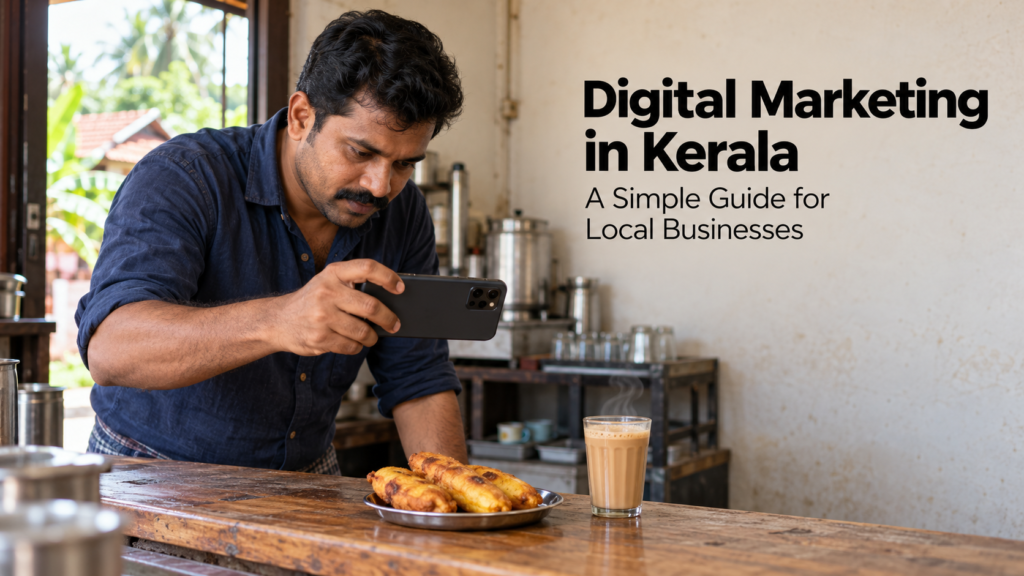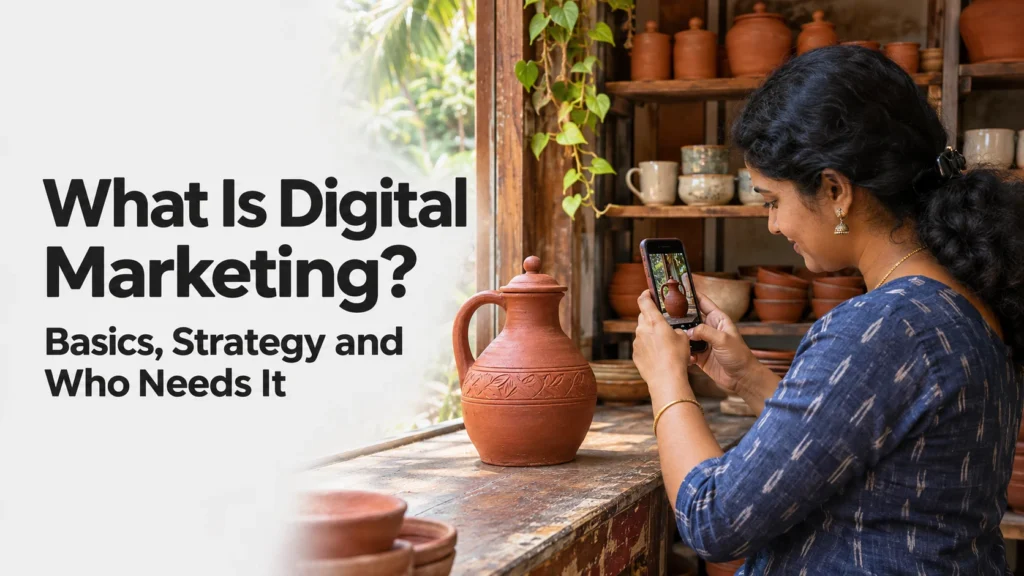
Hi, I am Sinan Moosa, a digital marketer in Kannur, Kerala. I am still a learner, so I will explain this the way I understand it, in simple words and with examples from Kannur.
These are the four questions I hear most from friends and business owners: what is digital marketing, what are the basics, what is a digital marketing strategy, and who needs digital marketing services. This blog answers all four, one by one. Read slowly, and come back to it whenever you need.
What is digital marketing?
Digital marketing means helping people find your business online, trust it and buy from it. Any marketing that happens on the internet or on a phone screen comes under it.
Think about how you decide to buy something today. You search on Google. You open Instagram and check the photos. You read reviews. You ask a friend on WhatsApp. A business that shows up in all of these places, in a good way, is doing digital marketing.
It is not only posting on Instagram, and it is not only running an ad. It is a mix of different parts that work together. Some people think boosting one post is digital marketing. That is only one small piece.
How is it different from traditional marketing?
Traditional marketing is things like newspaper ads, pamphlets, flex boards and radio. They still work for some businesses. But they have two problems. First, you cannot easily know who saw them. Second, you cannot change them quickly once they are printed.
Digital marketing is different in three ways:
- You can choose your audience. For example, people in Kannur who like food, or people searching for a dental clinic.
- You can see the results. Calls, clicks, messages and visits can be counted.
- You can change fast. If a post or an ad is not working, you can fix it today.
This does not mean flex boards are dead. A shop in Kannur can use both. But if your customers are on their phones, your business must be there also.
Why digital marketing matters in Kerala
Kerala is a special market. Here is why digital marketing is very important here:
- People search and compare. Many customers check Google and Instagram before they visit a place.
- Trust is everything. Reviews, photos and word of mouth decide a lot, and now word of mouth also happens on WhatsApp.
- Gulf and NRI families. Many families have someone abroad. A good online presence helps you reach them also.
- Festival seasons. Onam, Vishu, Eid, Christmas and wedding season bring big chances for offers.
- Two languages. Using Malayalam and English together helps you reach more people.
If your business is not online, many customers will never know it exists. The food may be very good and the shop may be very nice, but if people cannot find you, they will go to the one they can find.
What are the basics of digital marketing?
In my learning, I see 4 main parts. If you understand these four, you have a strong base.
1. Social media management (SMM)
SMM means managing your social media pages in a proper way. Basically, it is optimizing your handles: the name, the bio, the links and the relevant posts.
There are so many platforms in the world. But in Kannur, the main ones are Instagram, Facebook and WhatsApp. A local business should start with these three and not try to be everywhere.
- Instagram is good for photos and reels. Many people check a place here before they go.
- Facebook is still used by many families and older customers in Kerala.
- WhatsApp is where most deals happen. A WhatsApp Business account with a catalogue and a quick reply helps a lot.
A common mistake is posting only offer posters. People get bored. Mix in useful and interesting posts, like how your food is made, your team, and happy customers.
2. SEO (Search Engine Optimization)
SEO means making your website or your local presence show at the top of search engines.
For example, when someone searches “digital marketer in Kerala” or “digital marketer in Kannur”, which website shows first? That is SEO working. And when someone searches “restaurant near me”, the Google Business Profile at the top of the map is the one that is well optimized.
Many beginners think SEO is only keywords, but keywords alone do not work. There are four types:
- On-page SEO: the things on your own pages, like titles, headings, helpful content and images.
- Off-page SEO: things outside your website, mainly other good websites linking to yours and your reputation online.
- Local SEO: for businesses that want customers from one area. It includes your Google Business Profile, reviews and the same name, address and phone number everywhere.
- Technical SEO: the behind-the-scenes part, like speed, mobile friendliness and errors that stop Google from reading your pages.
SEO takes time. A Google Business Profile can start helping in a few weeks. A website can need a few months. Be careful of anyone who promises number one on Google in 7 days.
I saw a restaurant in Mattool that was not visible on Google Business at all. People nearby could not find it on the map. After the profile was set up, they could. It was a small step, but it was the base of everything else.
3. Ads
Ads mean paying to show your business to people. The two main types are:
- Meta Ads: these run on Instagram and Facebook. You can choose the place, age and interests of the people who see them.
- Google Ads: these run on Google and YouTube. Your ad can show on top when someone searches for what you sell.
A simple way to remember: with Meta Ads you go to the people while they are scrolling. With Google Ads people come to you while they are searching.
The good thing about ads is speed. You can start today and get enquiries soon. The not so good thing is that when you stop paying, the ads stop. Also, if you run ads to a weak page, your money goes waste. So fix your Google profile, your social media and your website first.
4. Content marketing
I think this is the soul of marketing. Whatever you do, you need content. SMM needs content, SEO needs content, and ads also need content like a poster or a video. Without content, there is no digital marketing.
Content has many types:
- Poster: for offers, festivals and announcements.
- Video and reels: for showing your work, your food and your story.
- Carousel: swipe posts that explain something step by step.
- Story: quick updates that stay for 24 hours.
- Blog: longer articles on your website that answer questions and help you show on Google.
Before making any content, ask two questions: who is this for, and what do I want them to do after seeing it? If you do not know the answer, the content is just decoration.
Other parts you will hear about
- Email marketing: sending messages to people who agreed to receive them.
- WhatsApp marketing: sending offers and updates to your customers, only to those who agreed.
- Influencer marketing: working with people who already have an audience.
- Website: your own home online, where people can learn about you and contact you.
You do not need all of these on day one. Start with the four basics.
What is a digital marketing strategy?
A digital marketing strategy is a plan. It answers a few simple questions: what do I want, who do I want it from, and how will I reach them.
Without a strategy, posting and running ads is just guessing. A business may spend a lot of money and still not get customers, because there was no clear direction.
Many people can do digital marketing. They can post, design and run ads. But not everyone can plan. That is the difference between doing marketing and being a marketer.
How to make a simple strategy
Here are the steps, in simple words.
- Set one clear goal. Do you want more calls, more shop visits, more bookings or more online orders? Pick one to start.
- Know your customer. Who are they? Where do they spend time online? What do they need? A student in Kannur and a family in Kozhikode may need very different things.
- Find your reason to be chosen. Why should someone choose you and not the business next to you? It can be a special offer, fast service, a different style or a better price. Say it again and again.
- Get the basics ready. A complete Google Business Profile, clean social media pages, clear contact details and a mobile friendly website.
- Choose 2 or 3 channels. Use the channels where your customers really are. You do not have to be everywhere.
- Plan your content. Decide what you will post, how often and in which format.
- Fix a budget. Decide how much you can spend each month, including ads if you use them.
- Track the results. Count calls, enquiries, visits and orders, not only likes.
- Improve every month. Keep what works, stop what does not, and try something new.
A small example
Think of a small restaurant in Kannur. The goal is more families coming on weekends. The customer is a family within a short drive. The reason to choose them is a special weekend offer. The basics are a Google profile with photos and timing, and a clean Instagram page. The content is short reels of food and the offer. The channels are Instagram and Google. The results are tracked by asking every family how they found the place.
That is a strategy. It is simple, but it has direction.
Who needs digital marketing services?
Almost every business that wants customers can use digital marketing. But some need it more than others.
Local businesses
These are the businesses that depend on people nearby:
- Restaurants, cafes and bakeries: people search for food near them, and they check photos before they go.
- Clothing shops and boutiques: people like to see new designs on Instagram before visiting.
- Clinics and hospitals: people check reviews and trust before choosing a doctor.
- Salons and gyms: customers look at photos, results and reviews.
- Jewellery shops: festival and wedding seasons bring big demand, and people compare designs online.
- Real estate and builders: buyers search a lot and need to trust you before they call.
- Travel and tourism: people plan trips with Google, Instagram and reviews.
- Wedding services: photographers, caterers and decorators depend on showing their work.
- Schools, tuition and coaching centres: parents search and compare.
Online and growing businesses
- Online sellers and small brands: they need people to find their products and trust their page.
- Startups: they have no name yet, so digital marketing is the fastest way to be seen.
- Service providers and freelancers: designers, photographers and consultants need clients to find them.
Businesses that serve NRIs and the Gulf
If your customers or their families are abroad, like property, gold, gifts or travel, a strong online presence helps you reach them in a way that flex boards never can.
How do you know if you need it?
Ask yourself these questions:
- If I search my business on Google, do I find correct details and photos?
- Do my customers ask “where are you?” or “what is your timing?” again and again?
- Do my competitors show up on Google or Instagram, and I do not?
- Do I depend only on word of mouth, and is it slowing down?
- Do I want to grow beyond my area?
If your answer is yes to even two of these, digital marketing can help you.
How to measure if digital marketing is working
Likes and followers feel nice, but they do not pay your rent. Track the things that matter:
- Calls and WhatsApp messages. Ask every new customer how they found you, and note it down.
- Google Business Profile numbers. Calls, direction requests and website clicks.
- Walk-ins and bookings. A simple notebook is enough.
- Website enquiries. Form fills and button clicks.
- Ad results. How much you paid for each enquiry.
- Sales from those enquiries. How many became real customers.
Check these every month, and make one small change at a time.
Mistakes to avoid
- Doing only one thing, like Instagram, and thinking it is all of marketing.
- Starting ads before the basics are ready.
- Posting with no plan or goal.
- Expecting SEO results in two weeks.
- Buying followers or fake reviews. It looks fake and hurts trust.
- Not replying to messages and reviews.
- Copying competitors without knowing why it works for them.
- Believing big promises like “number one on Google in 7 days”.
How to start, step by step
If you are a business owner:
- Search your own business on Google and see what customers see.
- Create or fix your Google Business Profile.
- Clean up your Instagram and Facebook pages with the same name, bio and details.
- Post 3 pieces of useful content each week.
- Reply to every message and review within a day.
- Add ads only when the basics are ready.
If you are a beginner who wants to learn:
- Learn the four basics first, without going deep.
- Practice on your own page or on a business you know, with permission.
- Pick one part to go deeper, like SEO, ads or content.
- Look at the results, not only the likes.
- Keep learning every week.
Learn more: websites and PDFs
If you want to read from bigger sources too, these are good places to start:
- What Is Digital Marketing? (HubSpot)
- What Is Digital Marketing? (Semrush)
- The Ultimate Guide to Digital Marketing Strategies (Semrush)
- Digital Marketing Guide for Beginners (Pipedrive)
- What Is Digital Marketing? The Beginners Guide (CareerFoundry)
- A Step-by-Step Guide to Local Business SEO (Semrush)
- Business Metrics: What to Track (Semrush)
- Google SEO Starter Guide
- Google Search Central guide (PDF)
- Free SEO eBooks list, with PDF downloads (Reliablesoft)
- Free online marketing courses (Reliablesoft)
- Google Skillshop: Google Ads training
Final words
Digital marketing looks big at first, but it is easy to understand when you break it into parts. Social media, SEO, ads and content are the base. A strategy is the plan that connects them. And almost every business that wants customers can use it.
I am still learning, and I enjoy sharing what I learn along the way. If you own a business in Kannur or anywhere in Kerala and want a simple plan for your online presence, I am happy to talk. I am Sinan, a digital marketer in Kannur, and I work with local businesses in Kerala.